

Build checkout form with Klarna WebSDK
Integrate Klarna’s Web SDK to deliver a seamless, optimized checkout experience on your site. Initialize the SDK, present Klarna in the payment selector, and finalize the flow with Klarna’s payment button.
20 min read
Prerequisites
Before you integrate, check that you meet the following prerequisites:
- 1.Ensure that you have Klarna enabled with Paytrail.
- 2.Confirm you have access to the Klarna Partner Portal.
- 3.Inside Klarna Partner Portal:
- 3.1.Confirm that you have generated a client identifier with your domain URL allowlisted.
- 3.2.Confirm that you have generated an API key.
- 4.Confirm that you have registered webhooks for
payment.events following Webhooks guidelines.request. state-change. completed - 5.Add Terms and Conditions for Web SDK.
Integration overview
Here's an overview of all the steps to display Klarna and initiate payments via the WebSDK:
- 1.Present Klarna as a payment option in the payment form.
- 2.Customer clicks the Klarna payment button in your checkout.
- 3.You create a server-side payment request to Klarna and share available interoperability data points.
- 4.If customer interaction is required, Klarna returns a
payment_.request_ id - 4.1.The
payment_is used to initiate the purchase flow with Klarna’s Web SDK.request_ id - 4.2.The Klarna Purchase Journey is launched.
- 4.3.The customer completes the Klarna Purchase Journey.
- 5.Klarna returns a
klarna_via webhook.network_ session_ token - 6.You create an authorization request with Paytrail and share the required interoperability data points.
- 7.Paytrail responds with an approval and order completion.
- 8.Customer is redirected to your confirmation page.
sequenceDiagram
autonumber
participant C as Customer
participant P as Partner
participant K as Klarna
participant AP as Paytrail
C->>P: Visit checkout page
P->>K: Initialize Klarna Web SDK
P->>K: Request presentation instructions
K-->>P: Return presentation assets and instructions
P->>P: Render payment selector
C->>P: Select Klarna
P->>P: Update payment selector<br/>Show Klarna payment button
C->>P: Click Klarna payment button
P->>K: Initiate callback triggered
K-->>P: Provide klarnaNetworkSessionToken
P->>K: POST payment/requests
Note over P,K: klarnaNetworkSessionToken
alt If customer authentication is required
K-->>P: Return paymentRequestUrl
P->>K: Forward paymentRequestUrl to Klarna Web SDK
K->>C: Launch Klarna purchase journey
C->>K: Complete Klarna purchase journey
end
K->>P: Payment request completed event<br/>(Webhook)
Note over K,P: klarnaNetworkSessionToken
P->>AP: Confirm payment
Note over P,AP: klarnaNetworkSessionToken
AP->>K: POST payment/authorize
Note over AP,K: klarnaNetworkSessionToken
K-->>AP: Authorization result<br/>(APPROVED)
AP-->>P: Order completed notification
P-->>C: Display confirmation message
Integration details
Presenting Klarna in the payment form involves retrieving the visual assets, localized text, and display instructions required to correctly render Klarna as a payment option and display the payment button. This dynamic presentation ensures a consistent customer experience, accurate localization, and optimized conversion performance, while adapting seamlessly to different checkout states.
On a high level, the process involves:
- 1.Initialize Klarna Web SDK in your checkout experience.
- 2.Request Klarna’s payment presentation for the current payment context.
- 3.Render Klarna payment option(s) dynamically in the payment form according to the instructions.
- 4.Allow the customer to select and deselect a Klarna payment option.
- 5.Display the Klarna button and start the payment process when clicked.
The expected outcomes are as follows:
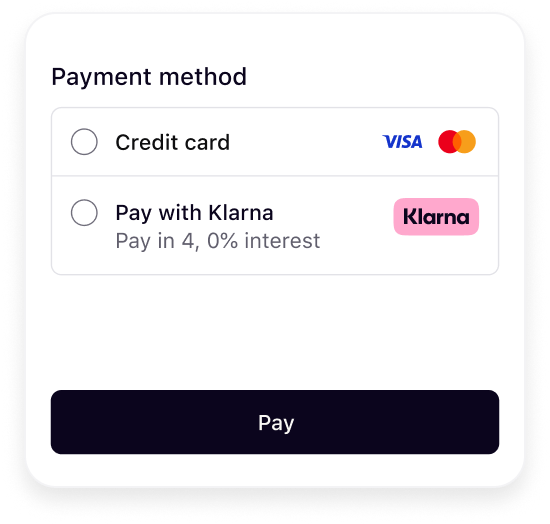 | 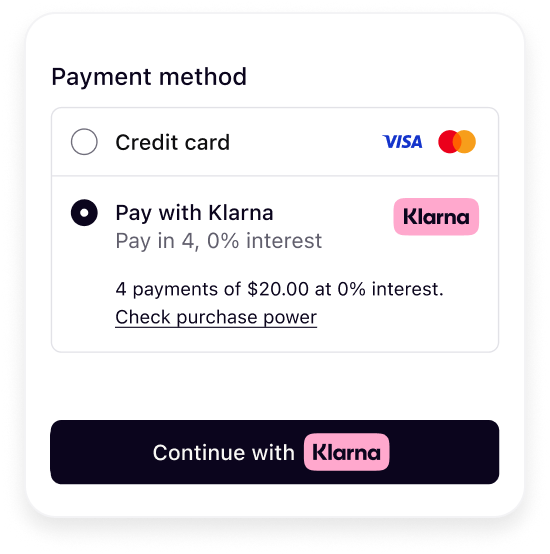 |
| Initial presentation | When Klarna is selected |
Present Klarna dynamically for best conversion
Klarna's payment presentation best practice
To ensure the best user experience and optimal conversion rates when presenting Klarna as a payment option, please apply the following recommendations:
- Display Klarna descriptor dynamically alongside other payment options in your payment form.
- Embed Klarna’s UI elements directly in your frontend for a consistent and responsive design.
The next sections in this guideline will walk through how this can be achieved using Klarna Web SDK.
Initialize the Klarna Web SDK
The Klarna Web SDK (klarna.mjs) follows the JavaScript module approach and should be included in places where you need to have a reference to the SDK such as while rendering any components or initiating a payment flow. Here are the initialization parameters:
| Parameter | Presence | Description |
|---|---|---|
clientId | required | A credential used to identify the Partner, which can be obtained from the Klarna Partner Portal. To ensure the credential functions properly, make sure to register all domains where the Web SDK will be used. |
products | optional | An array used to specify which products should be loaded to optimize performance by limiting the amount of data downloaded. If the PAYMENT product is included, only the Klarna. package will be loaded. If the products array is omitted, all available packages will be loaded by default. |
locale | optional | Language and region code (e.g., en-US). If omitted, Klarna may default based on the customer’s browser settings. |
For the full API specifications, refer to Klarna Web SDK.
SDK initialization sample
JAVASCRIPT
1
2
3
4
5
6
7
8
9
10
<script type="module">
const { KlarnaSDK } = await import("https://js.klarna.com/web-sdk/v2/klarna.mjs")
const Klarna = await KlarnaSDK({
clientId: "[client-id]",
products: ["PAYMENT"],
locale: "en-US", // optional
})
// Klarna SDK ready to be utilizedIntegration requirement
If the domain is not registered, subsequent method calls will result in an error.
When loading the Web SDK, follow these practices:
| Do | Don't |
|---|---|
Load the Web SDK from https:/ to remain compliant. | Host the Web SDK yourself, whether bundled or served from your own server. |
Keep the SDK in the top-level (first-party) browsing context. | Load the Web SDK inside an iframe. |
Specify products for performance. | Omit products. |
Disclose Web SDK tracking in your site's notices (learn more). | Use the Web SDK without disclosing tracking technologies. |
Klarna payment presentation request
Klarna payment presentation provides all the visual assets, localized texts, and instructions needed to correctly display Klarna in your checkout form.
Use the initialized SDK instance to call the Klarna.Payment.presentation() method.
Basic checkout context parameters must be provided:
| Parameter | Presence | Description |
|---|---|---|
amount | conditional | The transaction amount in minor units following ISO 4217 exponents (e.g., $118.00 = 11800, ¥1400 = 1400). This field is required if any of the intents include PAY, SUBSCRIBE, or DONATE; otherwise, it is optional. |
currency | required | Three-letter ISO 4217 currency code (e.g., USD, EUR). |
locale | optional | Locale code to localize texts and formats (e.g., en-US, de-DE). If you don’t set this, it will automatically use the value chosen when you first set up the Web SDK. If that’s not available, it will use your browser’s settings instead. |
intents | optional | Specify the intent of the checkout flow: PAY, SUBSCRIBE, SIGNUP, SIGNIN, DONATE, ADD_. If omitted, intents defaults to ["PAY"]. |
For the full API specifications, refer to Klarna Web SDK.
Recommended for integration
Performance optimization
It is important to ensure that Klarna is displayed at roughly the same time as other payment methods, with an acceptable delay of less than 100 ms. To achieve this, begin initializing the Klarna Web SDK and invoke the payment presentation method concurrently while loading the list of all enabled payment methods from your server.
Sample code
JAVASCRIPT
1
2
3
4
5
6
7
const paymentPresentation = await klarna.Payment.presentation({
amount: 11800,
currency: "USD",
locale: "en-US",
intents: ["PAY"]
});
Klarna payment presentation response
The
PaymentPresentation interface provides the full Klarna branding package and instructions tailored to the customer's purchase:| Attribute | Presence | Purpose |
|---|---|---|
instruction | required | Specifies how Klarna as a payment option(s) should be displayed (e.g., whether to show, preselect, or display as show-only). Adhering to these payment presentation instructions ensures customers have the best possible experience and optimizes conversion rates. |
paymentOption | optional | Defines the default payment option applicable to all purchase types. This object includes the visual elements required to represent Klarna during checkout. |
The
paymentOption object structure is as follows:| Attribute | Presence | Purpose |
|---|---|---|
paymentOptionId | required | The identifier of the payment option. The value is required to be sent to the Payment Authorize API or the Payment Request API when initiating the payment. |
icon | required | Klarna badge/logo suitable for checkout forms. |
header | required | The main descriptor that introduces Klarna in the payment form. The value will be dynamically adjusted based on the locale provided. |
subheader | required | The descriptor subheader which must be loaded inline below the main descriptor header. Short and enriched descriptive texts. Provides transparency on available options like installments, pay later, etc. |
message | optional | Enriched tailored description with link. |
badge | optional | Badge used for saved options or promotions. |
terms | optional | Defines terms/disclosures potentially with links. |
paymentButton | required | Payment button that starts the Klarna Purchase Journey. |
For the full API specifications, refer to Klarna Web SDK.
Follow Klarna payment presentation instruction
This section describes how to apply Klarna’s payment presentation instructions, which define how Klarna should appear in your checkout. Following these instructions ensures a consistent experience across payment states and is required for features like Klarna Express Checkout and Sign in with Klarna.
The
instruction attribute has the following values:| Instruction | Description |
|---|---|
SHOW_ | Show Klarna alongside other payment methods. |
PRESELECT_ | Show Klarna pre-selected but still alongside others. This is returned when using the customer_ issued from the Sign in with Klarna feature or the tokenization flow. |
SHOW_ | Show Klarna as the only payment method. This is returned when the customer has finished the first step of Klarna Express Checkout multistep. |
For the full API specifications, refer to Klarna Web SDK.
Conversion Boost features only
Skip this section if you don't use any Conversion Boost features from Klarna such as Klarna Express Checkout, Sign-in with Klarna, Klarna Messaging or Klarna Prequalification.
Here are example outcomes illustrating how Klarna should be displayed for each instruction:
| 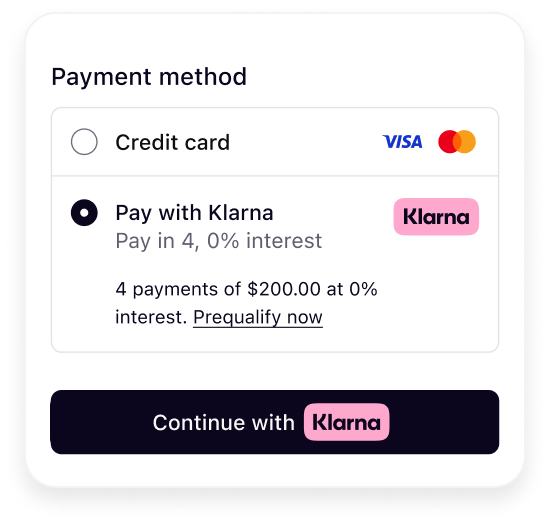 | 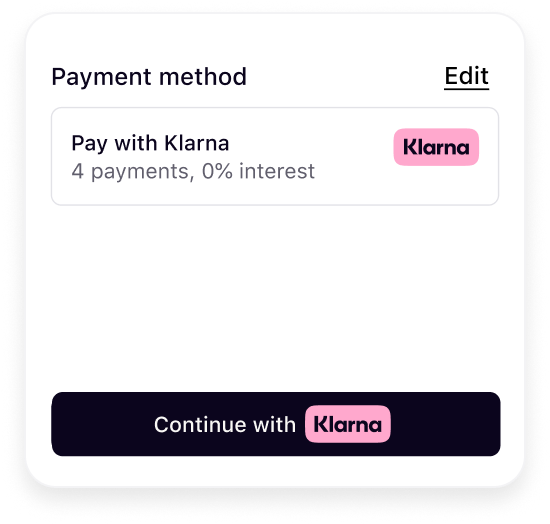 |
| Show Klarna | Preselect Klarna | Show only Klarna |
The presentation instructions are derived from possible customer purchase journeys described in the How to present Klarna article.
Sample code:
JAVASCRIPT
1
2
3
4
5
6
7
8
9
10
function renderKlarna(paymentPresentation) {
  if (!paymentPresentation) return;

  const root = qs("#klarna-payment-method");
  if (!root) {
    console.error("Missing #klarna-payment-method container.");
    return;
  }

root.innerHTML = `<div id="klarna-option-default" class="klarna-option default" style="display:none;">Mount Klarna payment option components
Once an instance of
PaymentPresentation is created, the Klarna payment option(s) must be rendered dynamically in the payment selector according to Klarna’s presentation guidelines. The following diagram displays different visual components and how they are rendered in different selection states:- 1.Icon
- 2.Badge
- 3.Header
- 4.Subheader
- 5.Message
- 6.Terms
- 7.Button
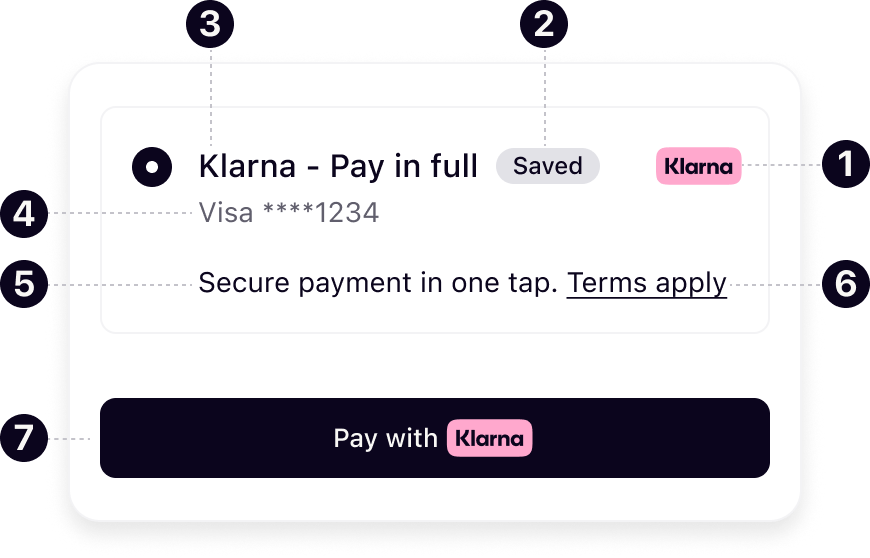
Mount the Klarna payment option components within your designated Klarna payment method container to render them dynamically in the payment form. Ensure that all components—including those not immediately visible—are mounted during initialization, and manage their visibility through your own logic or UI controls.
JAVASCRIPT
1
2
3
4
5
6
7
8
9
10
function renderKlarnaOption(containerId, option) {
  const container = qs(`#${containerId}`);
  if (!container) {
    console.error(`Missing #${containerId} container.`);
    return;
  }

  const ids = {
    icon:    `${containerId}-icon`,
header: `${containerId}-header`,Handle Klarna payment option selection and deselection
When a Klarna payment option is selected/deselected, ensure the additional visual components are shown/hidden properly.
JS
1
2
3
4
5
6
7
8
9
10
/**
 * Toggle the Klarna payment option selected state.
 * Use for both SDK preselection (PRESELECT_KLARNA) and user interactions.
 */
function toggleKlarnaPaymentOptionSelection(containerId, isSelected) {
  const container = qs(`#${containerId}`);
  if (!container) {
    console.error(`Missing container #${containerId}.`);
    return;
}Handle Klarna payment button styling and initiate callback
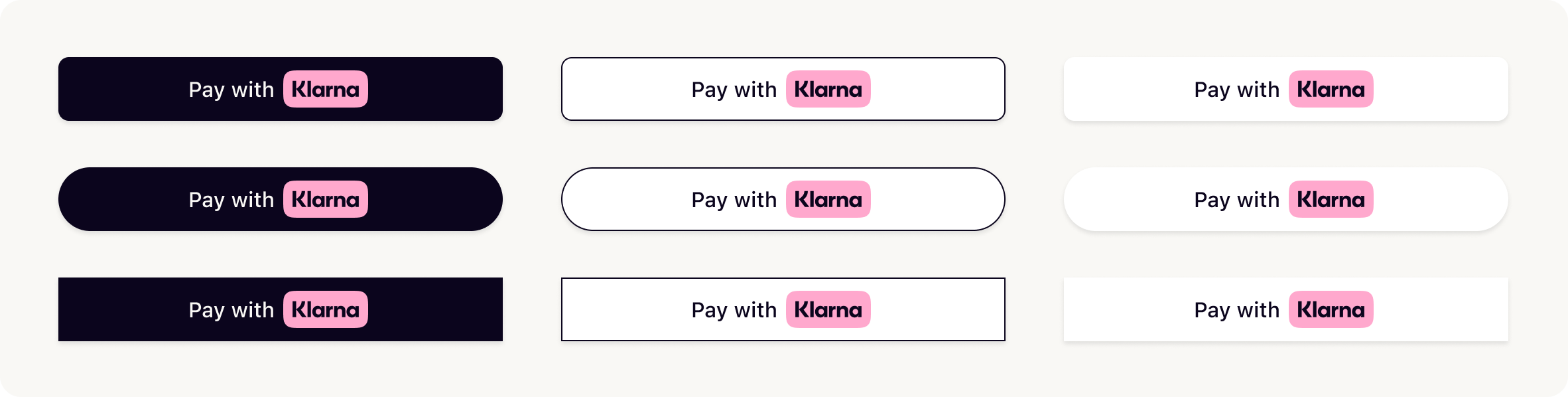
The payment presentation instance allows you to mount the prebuilt button component. The Klarna Payment Button is context-aware and dynamically adapts to your configuration.
[ Klarna payment button variants]
Choose the theme and shape of the payment button to best fit into your online store in a way that complements your brand and encourages user engagement. More details on the button styling can be found here.
[ Configure Klarna payment button]
The
paymentButton. can be configured with the following set of parameters:| Parameter | Description |
|---|---|
id | Sets a custom DOM ID on the rendered button. Useful for testing or styling. |
shape | Defines the button’s shape. Possible values are:default, pill, rect |
theme | Sets the visual theme of the button. Possible values are: default, light, dark, outlined |
locale | Sets the language and region (e.g., en-US). If you don’t set this, it will automatically use the value chosen when you first set up the Web SDK. If that’s not available, it will use your browser’s settings instead. |
disabled | Disables the button when set to true. Useful during form validation or async operations. |
loading | Forces the button into a loading state. Useful when awaiting async setup or validation. |
intents | Sets the purpose of the payment. Used to personalize the button and flow if not set when creating the PaymentPresentation instance. |
initiate | Function that returns a Promise resolving to either a PaymentRequestData, a paymentRequestUrl, or a returnUrl. This will be handled differently depending on the integration path. |
initiationMode | Defines how Klarna launches the Klarna Purchase Journey. |
For the full API specifications, refer to Klarna Web SDK.
Sample code
JAVASCRIPT
1
2
3
4
5
6
7
8
9
10
option
  .paymentButton
  .component({
    id: "klarna-payment-button",  // optional test hook
    shape: "pill",                // "default" | "pill" | "rect"
    theme: "default",             // "default" | "light" | "dark" | "outlined"
    intents: ["PAY"],
    initiationMode: "DEVICE_BEST", // "DEVICE_BEST" | "ON_PAGE" | "REDIRECT"
    initiate: (klarnaNetworkSesionToken, paymentOptionId) => initiateKlarnaPayment(klarnaNetworkSesionToken, paymentOptionId)
})Automatic purchase flow trigger
The button will automatically handle customer interaction and trigger the Klarna purchase flow via the
initiate function.Initiate the Klarna Purchase Journey
In order to launch the purchase flow, you need to implement the
initiate callback on the Klarna payment button interface. The initiate callback is triggered when the customer clicks on the Klarna payment button, upon which, the payment request data such as amount and currency must be submitted to Klarna server.| Parameter | Presence | Description |
|---|---|---|
currency | required | Currency in ISO 4217 format. Supported currencies: AUD, EUR, CAD, CZK, DKK, HUF, MXN, NZD, NOK, PLN, RON, SEK, CHF, GBP, USD. |
amount | required | Total amount of a one-off purchase, including tax and any available discounts. The value should be in non-negative minor units. Eg: 25 Dollars should be 2500. This is the amount that Klarna will charge the customer for a one-off purchase. Should not include any amounts for subscriptions. |
supplementaryPurchaseData | optional | Additional details about the transaction that reduce fraud risk and improve transparency. When sharing client-side through the Web SDK, only purchaseReference, lineItems, shipping, customer, subscription, and ondemandService are supported; industry and regulated packages — such as travel_, lodging_, event_, vouchers, insurances, and marketplace_ — must be shared server-side. |
For the full API specifications, refer to the createPaymentRequest .
.
.Create Klarna payment request on the server side and initiate the purchase flow using Klarna Web SDK
Create a payment request on the server side is the recommended approach to create the payment request, then share the payment request ID as response to the
initiate callback.Client code
JAVASCRIPT
1
2
3
4
5
6
7
8
9
10
const klarnaPaymentButton = klarna.Payment.button({
  initiate: async () => {
    const resp = await fetch('/create-klarna-payment-request', {
      method: 'POST',
      headers: { 'Content-Type': 'application/json' },
      body: JSON.stringify({ /* Your data here */ })
    });
    const data = await resp.json();
    return { paymentRequestUrl: data.paymentRequestUrl };
}For the full API specifications, refer to Klarna Web SDK.
Server code
JAVASCRIPT
1
2
3
4
5
6
7
8
9
10
// Server.js
// Simplified backend example for creating a Klarna payment request

const axios = require('axios');

// Klarna credentials and base URL (replace with your keys and consider loading from environment variables)
const KLARNA_API_KEY = 'YOUR_API_KEY';
const KLARNA_BASE_URL = 'https://global-api.klarna.com'; // According to docs

// Function to create a Klarna payment requestFor the full API specifications, refer to the createPaymentRequest.
.Avoid reusing payment requests
Create a new payment request on every button click instead of reusing payment requests.
This guide outlines how to monitor the Klarna Payment Request as part of the step up scenario. On a high level:
- Understand payment request lifecycle in order to handle
COMPLETED,CANCELED,DECLINEDandEXPIREDstates properly. - Monitor and retrieve the
klarna_and/ornetwork_ session_ token customer_by using one or a combination of the following methods:token - Subscribing to
payment.webhook events (required)request. state-change. * - Reading the payment request
Payment request lifecycle
During the checkout process, the Payment Request will transition to various states. Find below an overview of the possible payment request states together with a transition diagram:
| State | Description | Next action |
|---|---|---|
SUBMITTED | Initial state. Payment requests can be updated until the customer enters Klarna Journey. | Handle step-up scenario. |
IN_ | The customer is actively in Klarna Purchase Journey. | Listen for state changes via webhook. |
COMPLETED | Customer completed the flow, pending final authorization. | Retrieve klarna_ and create a payment transaction. |
EXPIRED | Payment request expired (t≥3h). | Final state. No action. |
CANCELED | Payment request canceled by the integrator before authorization. | Final state. No action. |
DECLINED | Payment request has been declined during authorization. | Final state. No action. |
[ State transition diagram]
flowchart LR
Start((Start)):::teritiaryEntity --> SUBMITTED1[<b>SUBMITTED</b>]:::secondaryEntity
%% --------------------------------------------------
%% Submission Handling
%% --------------------------------------------------
subgraph Submission_Handling [<b>Submission handling</b>]
direction TB
SUBMITTED1 --> Decision1{ }:::teritiaryEntity
Decision1 -->|Customer enters
Purchase Journey| IN_PROGRESS[<b>IN_PROGRESS</b>]:::secondaryEntity
Decision1 -->|Acquiring Partner
cancels request| CANCELED1[<b>CANCELED</b>]:::primaryEntity
Decision1 -->|Acquiring Partner
updates request| SUBMITTED2[<b>SUBMITTED</b>]:::secondaryEntity
Decision1 -->|"Request expired
(≥ 3h)"| EXPIRED1[<b>EXPIRED</b>]:::primaryEntity
end
%% --------------------------------------------------
%% Purchase Journey Outcome
%% --------------------------------------------------
subgraph Purchase_Journey_Outcome [<b>Purchase journey outcome</b>]
direction TB
IN_PROGRESS --> Decision2{ }:::teritiaryEntity
Decision2 -->|Klarna accepts
purchase| COMPLETED[<b>COMPLETED</b>]:::primaryEntity
Decision2 -->|Customer aborts| SUBMITTED3[<b>SUBMITTED</b>]:::secondaryEntity
Decision2 -->|Acquiring Partner
cancels request| CANCELED2[<b>CANCELED</b>]:::primaryEntity
Decision2 -->|"Request expired
(≥ 3h)"| EXPIRED2[<b>EXPIRED</b>]:::primaryEntity
Decision2 -->|"Customer rejected - no payment methods available"| DECLINED[<b>DECLINED</b>]:::primaryEntity
end
Payment Request 3-hour window
A Payment Request remains open for 3 hours. Klarna recommends Partners proactively cancel Payment Requests which have not resulted in successful transactions, especially if your Payment Request timeout is less than 3 hours.
Monitor and retrieve klarna_network_session_token
To retrieve the required token(s), Klarna provides multiple integration methods. Subscribing to Klarna webhook events is required and may be combined with additional methods to improve resilience.
Using webhooks ensures reliable completion handling, particularly when the customer closes the browser before returning, network interruptions occur during redirects, or post-processing is required before notifying the customer.
The
klarna_ is issued by Klarna after the customer approves the purchase. Use this token to finalize the authorization and create the corresponding Klarna payment transaction.Integration requirement
The
klarna_ is valid for only 1 hour and must be used within this time frame to finalize the authorization.Method: Subscribe to webhook events (required)
Subscribe to the
payment. webhook event using the guidelines provided here. Klarna sends this event when the Payment Request reaches the COMPLETED state.This event indicates that the customer has finished the step-up interaction and that the Acquiring Partner can proceed with finalizing the authorization.
Sample payload
JSON
1
2
3
4
5
6
7
8
9
10
{
  "metadata": {
    "event_type": "payment.request.state-change.completed",
    "event_id": "d9f9b1a0-5b1a-4b0e-9b0a-9e9b1a0d5b1a",
    "event_version": "v2",
    "occurred_at": "2024-01-01T12:00:00Z",
    "correlation_id": "2d1557e8-17c3-466c-924a-bbc3e91c2a02",
    "subject_account_id": "krn:partner:global:account:live:HGBY07TR",
    "recipient_account_id": "krn:partner:global:account:live:LWT2XJSE",
"product_instance_id": "krn:partner:product:payment:ad71bc48-8a07-4919-[...]",Consult createPaymentRequest for a complete description of the webhook payload.
for a complete description of the webhook payload.Method: Read the payment request
As an alternative method, retrieve the Klarna token(s) by calling the readPaymentRequest.
.Once the Payment Request reaches the
COMPLETED state, the token(s) are available in the state_ object of the Payment Request.Sample payload
JSON
1
2
3
4
5
6
7
8
9
10
{
  "payment_request_id": "krn:payment:eu1:request:10be1d49-7beb-6b24-b9dd-8c14d0528503",
  "state": "COMPLETED",
  "previous_state": "IN_PROGRESS",
  "state_context": {
    "klarna_network_session_token":"krn:network:eu1:live:session-token:[...]"
  },
  "expires_at": "2025-02-26T17:25:34.534721775Z",
  "created_at": "2025-02-24T17:25:34.534721775Z",
"updated_at": "2025-02-24T17:25:34.534721775Z",Make sure to add the
klarna_ received via the webhook and the purchase details within the call to Paytrail /payments endpoint. If everything is implemented correctly, Klarna will approve the payment transaction.BASH
1
2
3
4
5
6
7
8
9
10
curl -X POST https://services.paytrail.com/payments \
  -H "Content-Type: application/json" \
  -d '{
     "amount": 3000,
     "currency": "EUR",
     ...
     "providerDetails": {
        "klarna": {
           "networkSessionToken": "krn:network:eu1:live:session-token:eyJhbGciOiJFU...",
"networkData": "{\"content_type\": \"application/vnd.klarna.example+json\",\"content\": ...}",In rare cases where there's discrepancy between the amount and purchase details submitted in the original payment request and the information submitted to Paytrail, Klarna may reject and ask the customer to approve the purchase again.
Related articles
Jump to section...