

Optimize Klarna transactions
How Partners can improve Klarna approval rates and reduce false declines by sharing complete and accurate purchase data — line items, purchase reference, customer details, and shipping information — at every stage of the transaction lifecycle.
8 min read
Sharing complete and accurate data with every payment is one of the most effective actions Partners can take to improve their Klarna integration. When Partners provide detailed information about products, customers, and shipping to the Acquiring Partner, Klarna can make more accurate authorization decisions — leading to higher approval rates, fewer false declines, and a better experience for customers.
Contractual data requirement
Providing complete purchase data — including line items, purchase reference, customer details, and shipping information — is a contractual requirement under the Klarna Network Rules. Beyond compliance, providing complete data is one of the highest-impact actions Partners can take to improve authorization rates, reduce disputes, and deliver a better customer experience.
What is purchase data
Purchase data is the set of information Partners provide alongside each payment request to the Acquiring Partner. The Acquiring Partner uses this data to complete the payment with Klarna on behalf of Partners. It includes:
- Line items — per-product details such as name, quantity, price, tax, images, and URLs
- Purchase reference — the customer-facing transaction identifier
- Customer details — name, email, phone, address
- Shipping information — delivery address, carrier, shipping method, and recipient details
Partners provide this data in the Acquiring Partner's payment API — not directly to Klarna. The Acquiring Partner is responsible for forwarding it to Klarna in the correct format. For data the Acquiring Partner's API doesn't support structurally (for example, travel reservations or customer purchase history), Klarna provides a separate passthrough mechanism called
klarna_. See Share purchase data through your Acquiring Partner for both mechanisms.Internal API parameter mapping
supplementary_ is the internal Klarna API parameter the Acquiring Partner populates when calling Klarna. Partners do not use this field name directly — Partners provide data through the Acquiring Partner's own API fields. The Acquiring Partner handles the mapping.How complete data improves conversion
Higher authorization rates and fewer false declines
Klarna's fraud assessment and underwriting models evaluate hundreds of signals in real time for every transaction. The more context Partners provide — product details, delivery information, customer identifiers — the more accurately Klarna can assess affordability and intent. This means more legitimate transactions get approved, while genuinely suspicious patterns are caught early.
More accurate data → smarter decisions → fewer false declines → higher conversion.
Faster dispute resolution
When a customer disputes a transaction, Klarna uses Partner data as part of the evidence package. If data is absent or inconsistent across the Payment Authorization, capture, and refund stages:
- Klarna cannot provide itemized evidence to support the dispute
- Refund mapping may fail, causing confusion for the customer and for Partners
- Resolution time increases and outcomes can be less favorable
Klarna's automated dispute resolution works best when data is complete and consistent across all stages of the transaction lifecycle.
The value of each data category
Line items
Line item data provides critical transaction context that improves Payment Authorization outcomes and enables a better customer experience. While line items may not always be mandatory in API requests, sending complete and accurate line item data is mandatory for all Payment Authorizations.
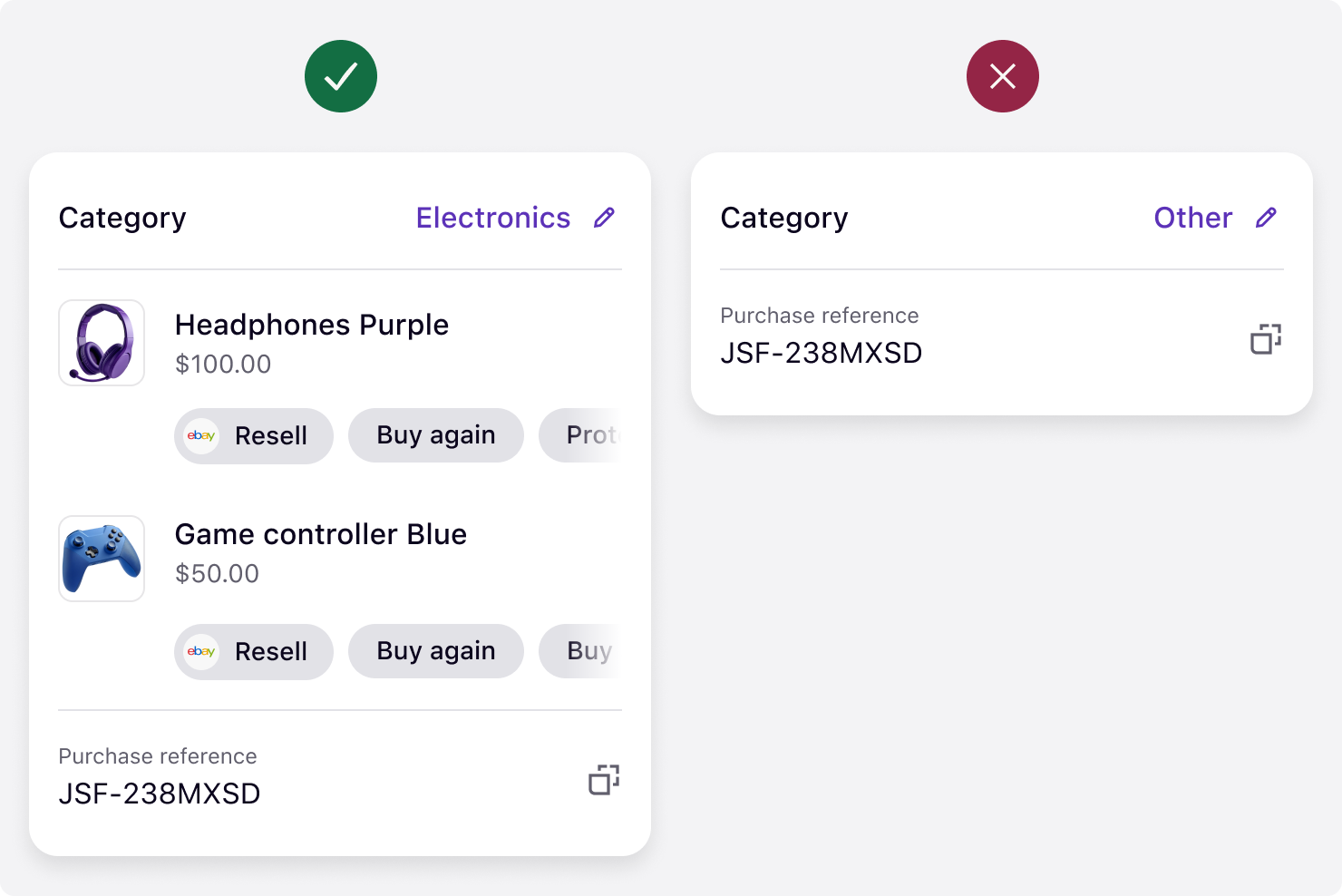
Transaction detail view with and without complete line item data
Authorization benefits:
- Enhanced fraud assessment — Detailed product information enables more accurate fraud detection and underwriting
- Improved approval rates — Complete transaction context leads to higher authorization approval rates
- Better customer verification — Product details help validate legitimate purchases and identify suspicious patterns
- Regulatory compliance — Detailed line items support compliance requirements
Customer experience benefits:
- Rich transaction displays — Clear product names, images, and prices in the Klarna app and email communications
- Buy Again feature — Enables customers to repurchase items directly in the Klarna app
- Reduced inquiries — Transparent transaction details reduce customer service contacts
- Transaction tracking — Better visibility into what was purchased and when
- Refund clarity — Clear mapping of refunded items to original purchases
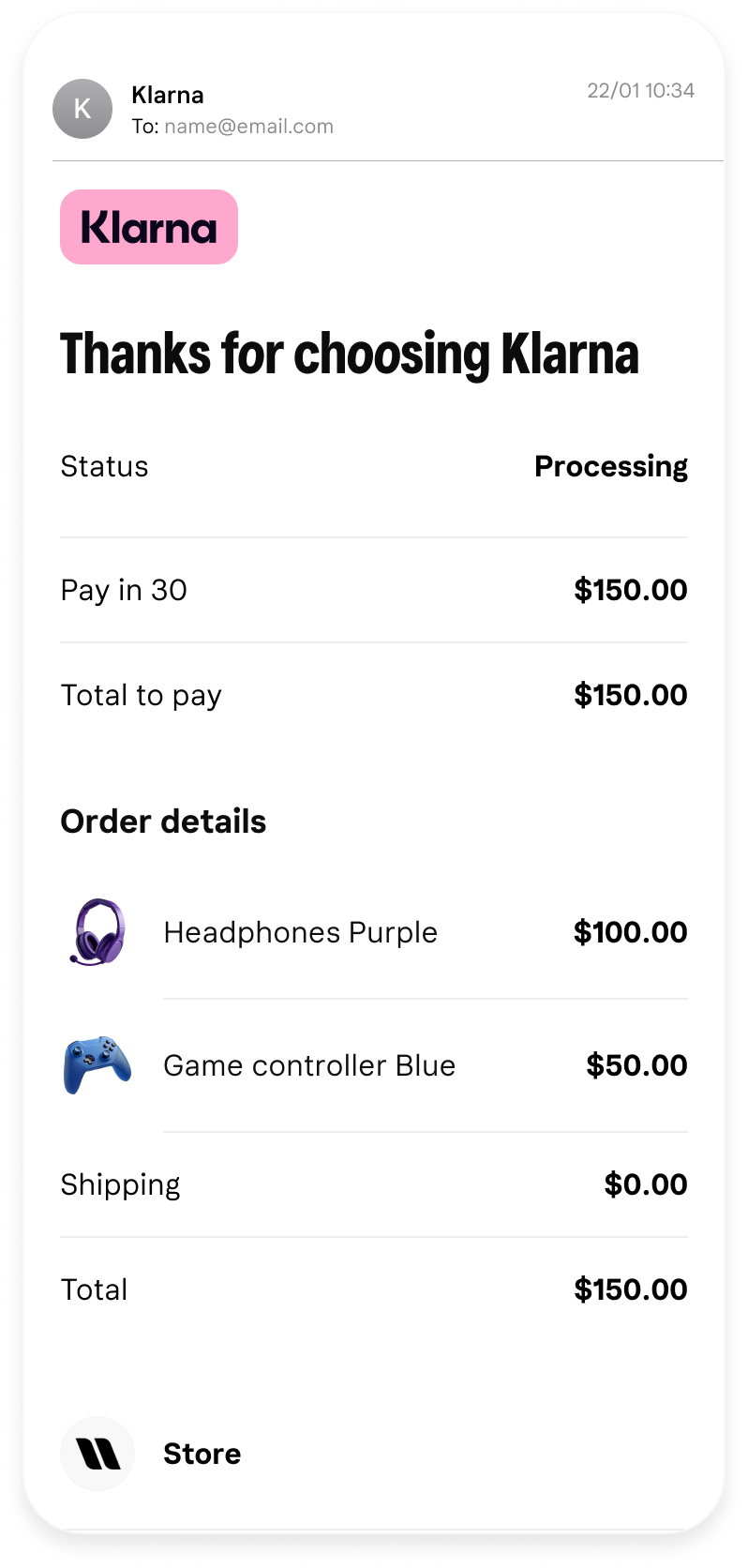 | 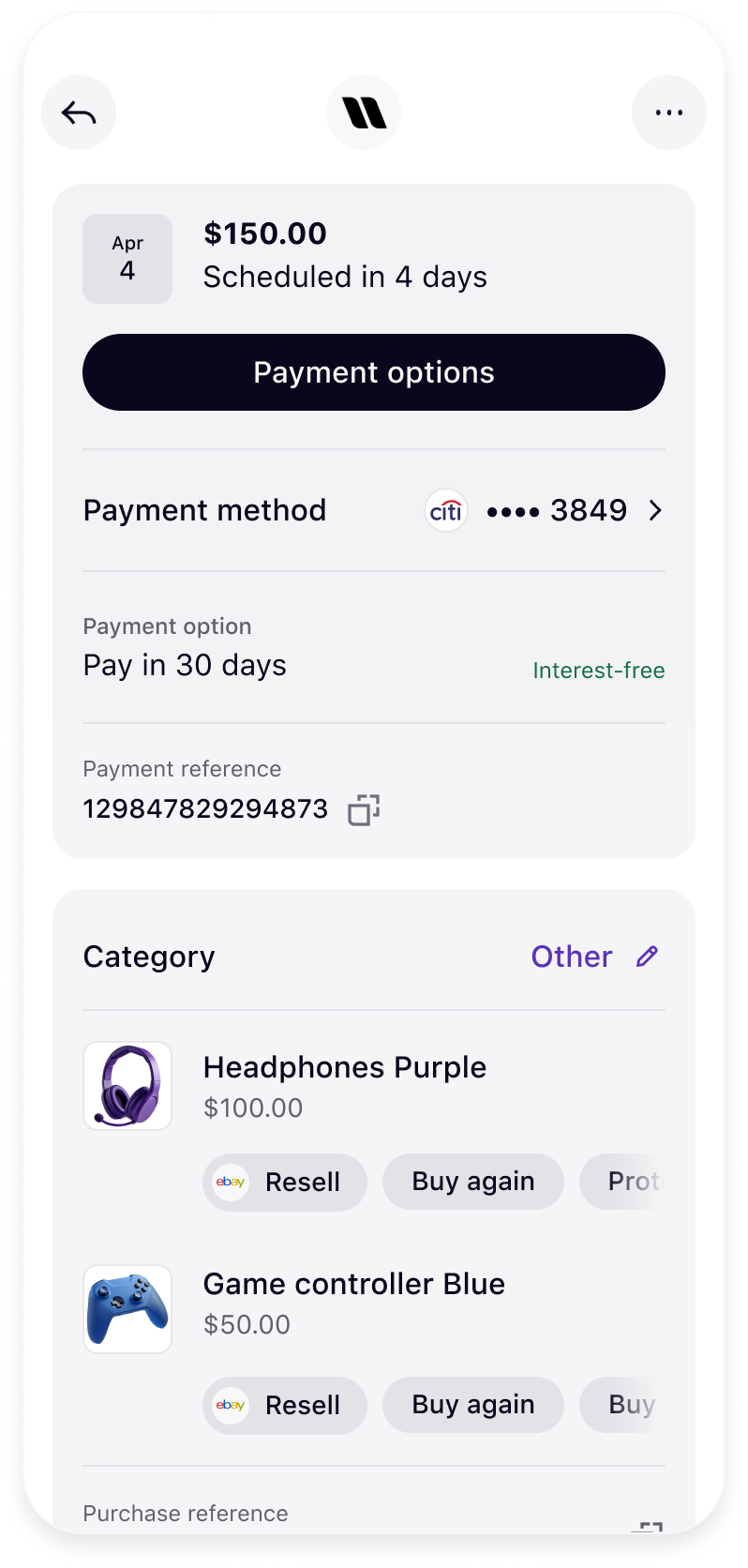 |
| Line item data in transaction email communication | Line item data in the transaction detail page |
Dispute resolution:
Consistent
name and product_ values across all operations (Payment Authorization, capture, refund) are essential for dispute evidence integrity. When these values change between stages, Klarna cannot reliably match items to build a defense.Purchase reference
The purchase reference is the customer-facing order identifier. It creates a consistent, traceable reference across Klarna touchpoints:
- Improves traceability across systems and simplifies reconciliation
- Appears in customer communications, making it easier for customers to identify their orders
- Simplifies dispute resolution by linking Klarna transactions to Partners' internal order records
- Ensures smoother customer communication and post-purchase experiences
Customer details
Providing customer data (name, email, phone, address) supports:
- Better fraud assessment — Klarna can verify identity and assess creditworthiness more accurately
- Personalized experiences — Enables tailored communication and offers through emails and push notifications
- Fraud prevention — Cross-referencing customer data with behavioral signals helps detect account takeover and synthetic identity fraud
- Reduced friction — Customer data pre-populates the Klarna purchase flow, reducing drop-off for both new and returning Klarna customers
Shipping information
Shipping details are critical for:
- Fraud prevention — Billing and shipping addresses are a key fraud signal. Providing both helps Klarna detect suspicious patterns without blocking legitimate gifting or multi-address scenarios
- Delivery transparency — Shipping carrier and method information supports proactive customer communication
- Post-purchase experience — Customers can track deliveries directly through Klarna
- Dispute evidence — Shipping details serve as proof of delivery intent and fulfillment
Impact across the order lifecycle
| Stage | How Partner data helps |
|---|---|
| Checkout | Complete data enables faster Payment Authorization decisions, higher approval rates, and reduced false declines. Customers see a smooth payment experience. |
| Post-purchase | Line items with images and URLs power rich order views in the Klarna app, enable Buy Again, and reduce "what did I buy?" support contacts. |
| Capture & fulfillment | Consistent data between Payment Authorization and capture ensures seamless order processing. Shipping details support delivery tracking and proactive communication, helping reduce order-related support inquiries. |
| Refunds & returns | Matching line item data across operations enables accurate refund mapping. Customers see exactly which items were refunded and why. |
| Disputes | Complete, consistent data across all stages provides the evidence package Klarna needs to resolve disputes quickly and accurately. |
Best practices
Apply these practices when sending purchase and line-item data to Klarna:
| Do | Don't |
|---|---|
Send complete line items — including image_ and product_ — whenever data is available at checkout. | Omit line items, or send only partial data across stages. |
Use clear, customer-facing product names (for example, "Men's Denim Jeans - Blue, Size 32"). | Use generic or internal names like "Product 1" or "Item". |
Include high-resolution product images (minimum 400×400px) using public HTTPS URLs. | Mark shipping fees as products or products as fees. |
Keep line items, purchase reference, and identifiers consistent across all operations. | Change names or identifiers between operations. |
Validate amounts, quantities, and tax values before submission — set total_ to 0 if no tax applies. | Send inconsistent or unsynchronized data so stages disagree. |
Data-driven quick wins
| Action | Why it matters |
|---|---|
| Include detailed line items | Helps Klarna approve more transactions by improving fraud assessment accuracy while streamlining disputes, returns, and in-app order visibility. |
| Provide complete shipping and billing details | Enables Klarna to verify identities, detect fraud, and assess delivery risk more accurately — improving approval rates and reducing false positives and support requests. |
| Add purchase reference and customer identifiers | Creates a consistent, customer-facing reference that improves traceability across Klarna touchpoints, simplifies disputes, and ensures smoother customer communication. |
| Send data consistently across all operations | Ensures Klarna can build complete evidence packages for disputes, accurately map refunds, and maintain a coherent customer experience throughout the order lifecycle. |
Better data = better decisions.
Every enriched data field helps Klarna's fraud assessment and underwriting models make faster and more accurate decisions — leading to more approvals, fewer false declines, and higher revenue for Partners.
Related articles
Jump to section...