

Build checkout form with Klarna Presentation API (Worldpay orchestrated)
Integrate Klarna without the Web SDK. Fetch the payment presentation server-side from Klarna, render Klarna yourself in the payment selector, and let Worldpay orchestrate the Klarna authorization.
Prerequisites
Before you integrate, check that you meet the following prerequisites:
- 1.Ensure that you have Klarna enabled with Worldpay.
- 2.Confirm you have access to the Klarna Partner Portal.
- 3.Inside Klarna Partner Portal:
- 3.1.Confirm that you have generated an API key with permission to call the Klarna Payment Presentation API.
- 4.Add Terms and Conditions for presenting Klarna.
This flow does not use the Klarna Web SDK. You call Klarna's Payment Presentation API server-side, render Klarna in your own payment selector, and delegate the authorization (including step-up handling and webhooks) to Worldpay. You don't need to register webhooks with Klarna or call Klarna's Payment Request API directly.
Integration overview
Here's an overview of all the steps to display Klarna and initiate payments without the Web SDK in the Worldpay-orchestrated flow:
- Your server calls Klarna's Payment Presentation API to retrieve assets and display instructions for the current purchase context.
- You render Klarna as a payment option in your payment selector using the returned assets.
- Customer selects Klarna and clicks the Klarna payment button.
- Your server forwards the purchase details to Worldpay to create the payment session.
- If customer authentication is required, Worldpay returns a
payment_request_urland you redirect the customer's browser to it. The customer then completes the Klarna Purchase Journey on Klarna's hosted page — you don't render or orchestrate anything during this phase. - Worldpay notifies you when the order is completed.
- You redirect the customer to your confirmation page.
Integration details
Present Klarna in the payment form
Presenting Klarna in the payment form involves retrieving the visual assets, localized texts, and display instructions required to correctly render Klarna as a payment option and display the payment button. In this flow you request the presentation server-side and render the option yourself using the returned assets.
On a high level, the process involves:
- 1.Request Klarna's payment presentation for the current payment context from your server.
- 2.Render Klarna payment option(s) in the payment form according to the instruction returned.
- 3.Allow the customer to select and deselect the Klarna payment option.
- 4.Display the Klarna button and start the payment process when clicked.
The expected outcomes are as follows:
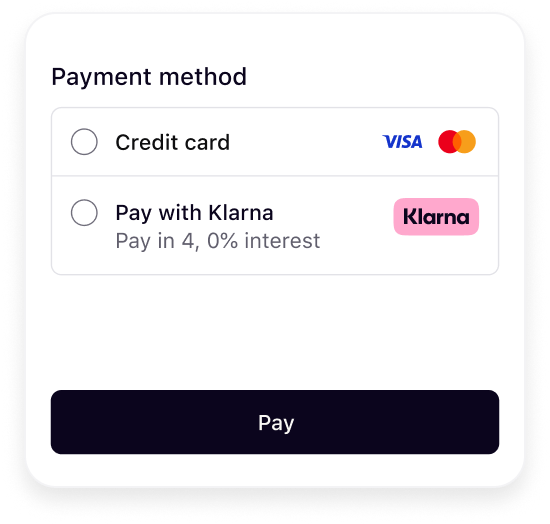 | 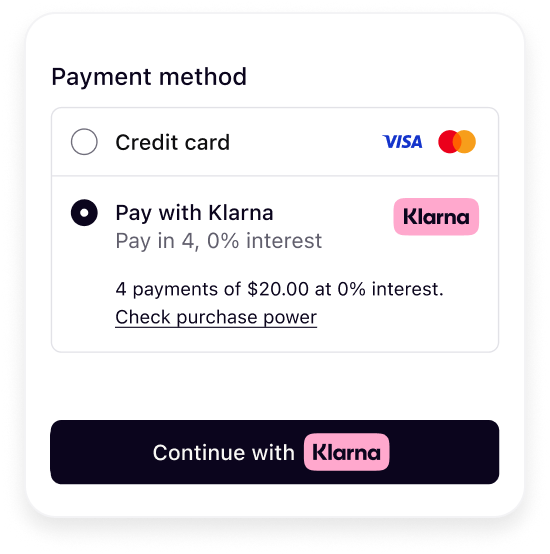 |
| Initial presentation | When Klarna is selected |
Klarna's payment presentation best practice To ensure the best user experience and optimal conversion rates when presenting Klarna as a payment option, please apply the following recommendations:
- Display Klarna descriptor dynamically alongside other payment options in your payment form.
- Use the assets returned by the Payment Presentation API — do not hard-code Klarna branding, copy, or badges in your checkout.
Klarna payment presentation request
Call the Klarna Payment Presentation API from your server to obtain the assets and the display instruction for the current purchase context.
Issue a GET request to /v2/accounts/{partner_account_id}/payment/presentation with query-encoded parameters. Authenticate with your API key using Authorization: Basic <API key>.
Basic checkout context parameters must be provided as query parameters:
| Parameter | Presence | Description |
|---|---|---|
partner_account_id | required (path) | Your Klarna-issued partner account identifier — the same value used elsewhere when you authenticate against Klarna. |
currency | required | Three-letter ISO 4217 currency code (e.g., USD, EUR). |
locale | required | Locale code to localize texts and formats (e.g., en-US, de-DE). |
amount | conditional | The transaction amount in minor units following ISO 4217 exponents (e.g., $118.00 = 11800, ¥1400 = 1400). Required when intent is PAY or SUBSCRIBE; otherwise optional. |
intent | optional | Intent of the checkout flow. Enum: PAY, SUBSCRIBE, ADD_TO_WALLET. Defaults to PAY. |
You don't send any acquiring or Payment Account configuration on this call — Payment Account selection is owned by Worldpay, not by you.
When a Klarna Conversion Boost experience (Klarna Express Checkout, Sign in with Klarna, a tokenized flow, Klarna Messaging / Prequalification, etc.) has already produced a session token in a previous step, forward it as an HTTP header so Klarna can restore the customer's context and return a richer presentation (for example PRESELECT_KLARNA or SHOW_ONLY_KLARNA):
| Header | Presence | Description |
|---|---|---|
Klarna-Network-Session-Token | conditional | The Klarna network session token obtained from a previous Klarna Conversion Boost interaction. Omit when no prior Klarna context exists. |
For the full request schema, consult the API reference .
.
Performance optimization Call the Payment Presentation API concurrently with loading the rest of your payment methods. Aim to display Klarna within 100 ms of the other payment options.
Sample request
curl -G https://api-global.test.klarna.com/v2/accounts/{partner_account_id}/payment/presentation \
  -H 'Authorization: Basic <API key>' \
  -H 'Content-Type: application/json' \
  -H 'Klarna-Network-Session-Token: krn:network:us1:test:session-token:eyJhbGciOiJIU[...]' \
  --data-urlencode 'locale=en-US' \
  --data-urlencode 'amount=15000' \
  --data-urlencode 'currency=USD' \
  --data-urlencode 'intent=PAY'
Sample response
{
  "instruction": "SHOW_KLARNA",
  "payment_status": "REQUIRES_CUSTOMER_ACTION",
  "payment_option": {
    "payment_option_id": "S0xBUk5BXzE3NzI3MDY2MTI2ODg=",
    "header": {
      "text": "Pay with Klarna"
    },
    "subheader": {
      "text": "Flexible payments, 0% interest"
    },
"message": {Klarna payment presentation response
The response provides the full Klarna branding package and the instruction tailored to the customer's purchase:
| Attribute | Presence | Purpose |
|---|---|---|
instruction | required | Specifies how Klarna as a payment option should be displayed (show, preselect, or show-only). Adhering to these payment presentation instructions ensures customers have the best possible experience and optimizes conversion rates. |
payment_status | required | Current state of the underlying payment context, e.g. REQUIRES_CUSTOMER_ACTION. |
payment_option | optional | Defines the default payment option applicable to all purchase types. Contains the visual elements and localized texts required to represent Klarna during checkout. |
The payment_option object structure is as follows:
| Attribute | Presence | Purpose |
|---|---|---|
payment_option_id | required | The identifier of the payment option. Forward this value to Worldpay when creating the payment session. |
icon | required | Object containing Klarna badge/logo assets in multiple aspect ratios (badge_image_url, square_image_url, rectangle_image_url) together with an alt text. Pick the variant that matches your checkout layout. |
header | required | Localized main descriptor that introduces Klarna in the payment form. Contains a text string. |
subheader | required | Localized subheader text to be displayed inline below the main descriptor. Provides transparency on available options (installments, pay later, etc.). Contains a text string. |
message | optional | Enriched tailored description. Returned as a parts array of segments where each part is either a plain TEXT segment (optionally with styles like BOLD) or a LINK segment containing a url and context. Render the parts in order. |
badge | optional | Badge text/asset used for saved options or promotions. |
terms | optional | Localized terms/disclosures. Same parts structure as message — supports text and link segments. |
payment_button | required | Label and icon for the Klarna payment button: text (button label), image_url (badge image to render next to the label), and image_alignment (LEFT or RIGHT). |
For the full response schema, consult the API reference.
All localized texts and asset URLs are returned ready to use. You are expected to render them as-is in your own HTML — do not translate, relabel, or substitute Klarna imagery.
Follow Klarna payment presentation instruction
This section describes how to apply Klarna's payment presentation instructions, which define how Klarna should appear in your checkout. Following these instructions ensures a consistent experience across payment states and is required for features like Klarna Express Checkout and Sign in with Klarna.
The instruction attribute has the following values:
| Instruction | Description | Example |
|---|---|---|
SHOW_KLARNA | Show Klarna alongside other payment methods. | |
PRESELECT_KLARNA | Show Klarna pre-selected but still alongside others. This is returned when the customer's context (for example a customer_token from Sign in with Klarna or a tokenization flow) has been forwarded via the Klarna-Network-Session-Token header. | 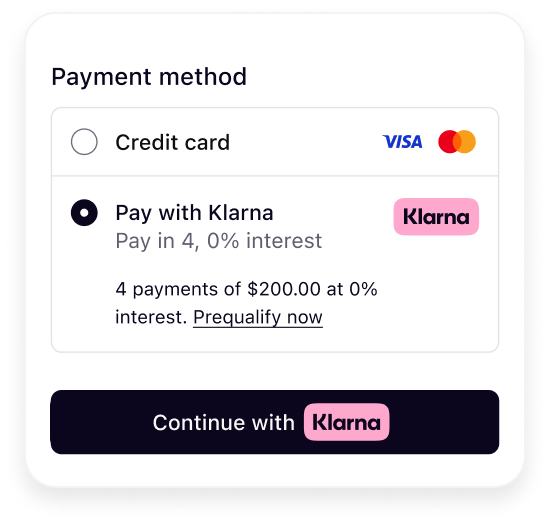 |
SHOW_ONLY_KLARNA | Show Klarna as the only payment method. This is returned when the customer has finished the first step of Klarna Express Checkout multistep. | 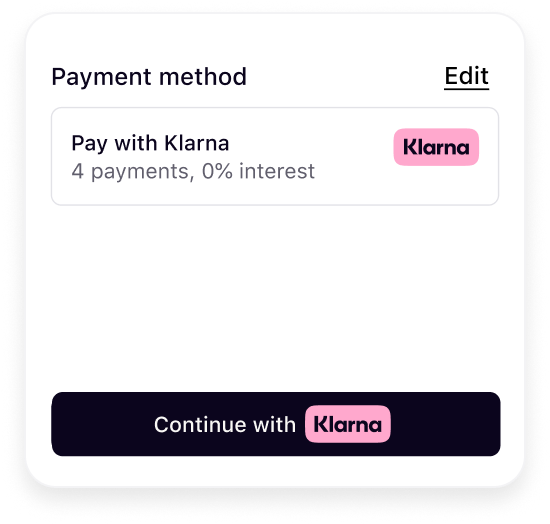 |
Skip this section if you don't use any Conversion Boost features from Klarna such as Klarna Express Checkout, Sign-in with Klarna, Klarna Messaging or Klarna Prequalification.
Render the Klarna payment option
Use the assets and localized strings from payment_option to render Klarna directly in your payment selector. The following diagram displays the visual components and how they are laid out:
- 1.Icon
- 2.Badge
- 3.Header
- 4.Subheader
- 5.Message
- 6.Terms
- 7.Button
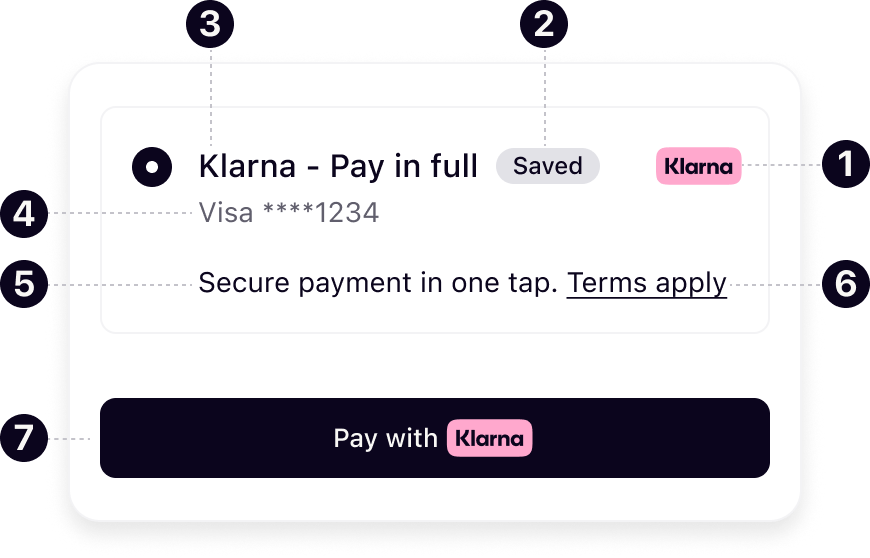
Ensure that all components — including those not immediately visible — are present in the DOM, and manage their visibility through your own logic or UI controls.
Sample HTML template
<!-- Server-rendered fragment using values from the Payment Presentation response -->
<div id="klarna-option" class="klarna-option" data-payment-option-id="{{ payment_option.payment_option_id }}">
  <img class="klarna-icon" src="{{ payment_option.icon.badge_image_url }}" alt="{{ payment_option.icon.alt }}" />

  {{#if payment_option.badge}}
    <span class="klarna-badge">{{ payment_option.badge.text }}</span>
  {{/if}}

  <div class="klarna-header">{{ payment_option.header.text }}</div>
  <div class="klarna-subheader">{{ payment_option.subheader.text }}</div>

{{#if payment_option.message}}The message and terms objects return a parts array rather than pre-rendered HTML. Render the segments in order, applying any styles flags and turning LINK parts into anchors. Use the rendering approach that fits your stack — the example below shows a minimal string-builder version:
function renderParts(parts) {
  let html = "";
  for (const part of parts) {
    if (part.type === "LINK") {
      html += `<a href="${part.url}" target="_blank" rel="noopener noreferrer">${part.text}</a>`;
    } else {
      const cls = part.styles?.includes("BOLD") ? "bold" : "";
      html += `<span class="${cls}">${part.text}</span>`;
    }
  }
  return html;
}- Use the icon URL, label, and texts returned by the Payment Presentation API verbatim.
- Render the
messageandtermsblocks when Klarna is selected. - Request a fresh presentation on every checkout load (amount/currency/locale can change between sessions).
- Don't hard-code the Klarna logo, badge, or copy — always use the returned assets.
- Don't strip or modify links from
messageorterms. - Don't cache presentation responses across purchases.
Handle Klarna payment option selection and deselection
When the Klarna payment option is selected, reveal the supporting components (message, terms, payment_button); hide them again on deselection. Use whatever UI pattern your checkout already follows for other payment methods — there's nothing Klarna-specific here.
Forward the purchase to Worldpay
When the customer clicks the Klarna payment button, your server hands the purchase off to Worldpay — Worldpay then calls Klarna's Payment Authorize API on your behalf. The full request/response contract is owned by Worldpay; only the Klarna-specific identifier you must include is documented here.
| Identifier | Where it comes from | Why Worldpay needs it |
|---|---|---|
payment_option_id | The payment_option_id returned by the Klarna Payment Presentation API for the option the customer selected. | Tells Worldpay which Klarna option to authorize so the journey it presents matches what the customer just saw. |
Refer to Worldpay's API reference for the full request shape (amount, currency, customer, shipping, line items, supplementary purchase data, response codes, etc.).
Create a new payment session on every Klarna button click — do not reuse a previous payment_request_url.
Handle step-up via redirect
If Worldpay returns STEP_UP_REQUIRED with a payment_request_url, perform a full-page HTTP 302 redirect to that URL. The customer completes the Klarna Purchase Journey on Klarna's hosted page, and Worldpay takes care of finalizing the authorization and notifying you of the outcome.
You don't need to subscribe to Klarna webhooks, monitor the Klarna payment request lifecycle, or handle the klarna_network_session_token yourself — Worldpay handles these on your behalf.
The final order-completed notification is delivered by Worldpay according to their own callback/webhook contract. Use it as the signal to display the confirmation page to the customer.
Receive the final order outcome
Once the payment is authorized — either directly or after a successful step-up — Worldpay notifies you that the order is completed. Redirect the customer to your confirmation page based on Worldpay's notification.
In rare cases where there's a discrepancy between the amount and purchase details submitted to Worldpay and the information Klarna sees during step-up, the authorization may be rejected and the customer asked to approve the purchase again through the step-up journey.
Related articles
API & SDK references