

Before you start with Dispute Management v3
Understand dispute reasons, response timelines and disputes fees.
20 min read
Disputes are a natural part of the post-purchase experience, allowing customers to raise concerns about their orders, such as returns, missing goods, or unauthorized transactions. Klarna’s Dispute Management system ensures these issues are handled in a fair, structured, and timely manner for both customers and Partners.
When a dispute is raise to Klarna, it is handle following a defined lifecycle, from the moment a customer submits a claim to the final resolution. And to understanding the dispute process is crucial to minimize financial losses, maintain customer trust, and stay compliant with Klarna’s terms.
This section is applicable for new integration of Disputes API, for mantainance of integration of V1 and v2 of Disputes API, please go here
Dispute Reasons
Klarna supports several dispute types, each corresponding to a different kind of customer issue. Understanding these categories is essential for responding appropriately and providing the correct evidence during the resolution process.
Each dispute type triggers a specific response flow within Klarna, and understanding the nature of the issue is the first step toward resolving it efficiently.
Below are the most common dispute types:
Return not refunded
The customer indicates they have returned one or more items from their order. They may be waiting for a refund or a corrected invoice. Partners are required to verify that the return has been received and to update the invoice accordingly.
Return not refunded example
Example: A customer returns shoes but the refund hasn’t been processed.
Timeline
The request has a deadline of 14 days.
Requested information
We will ask you if you received the return. If you did, please make sure to adjust the invoice of the related order. If you received the return but do not accept it, make sure to explain your reasoning in the comment section (´Add reply´).
Please note that if you select the option indicating that you will make adjustments to the statement you are committing to performing a refund equal to the disputed amount. If you do not perform said refund within 96 hours of responding, we will perform an automatic chargeback of the disputed amount.
- Have you received the return?*
- Yes, will make changes to the order
- Yes, but not accepted (Please specify why)
- Return not received
- Add reply (optional)
- Attachment (optional)
Products Not Received
The customer claims that the product or service never arrived. This may result from shipping delays, incorrect delivery, or failure to dispatch the item. The Partner is required to provide shipping details and proof of delivery.
Products not received example
Example: A package was marked as delivered by the carrier, but the customer reports non-receipt.
Timeline
The request has a deadline of 14 days.
Requested information
For dispute related to Goods not received you will be asked to select the delivery method that suits your order. These have been categorized into Physical Goods, Intangible Goods and On Demand/Food Delivery. Each category includes requests tailored to get the most relevant information pertaining to your dispute. Please note that you should only select the category that applies to your order.
Physical goods
Please provide us with the following details:
- A document or documents containing the following details:
- The tracking ID of the delivery
- The address to which the order was delivered
- The Date the order was delivered
- The delivery status of the parcel (optional)
- One piece of additional evidence to prove the entire order was delivered. Options include, but are not limited to, packing list or delivery note, weight of items and parcel etc.
- A signature from the customer showing the item was received (for orders >750 EUR) (optional) Intangible Goods
Please provide us with the following details:
- A document or documents containing the following details:
- The date the order was sent
- The email address the order was sent to (optional)
- The IP the order was sent to (optional)
- Any evidence the item was received, accessed or used (optional) On Demand/Food Delivery
Please provide us with the following details:
- A document or documents containing the following details:
- The customer's name (optional)
- The date and time of delivery (optional)
- The delivery status of the parcel (optional)
- The address to which the order was delivered (optional)
- The delivery choice (optional) In addition to the requests related to each category, the below information is required for all Goods not received disputes
- The tracking ID of the delivery
- The shipping carrier used to deliver the package
- The Date the order was delivered For information related to requirements, please refer to the Merchant Protection Program
Products Faulty
The customer believes that the received product is damaged, defective, or does not match the description on the website. Klarna may ask for documentation from both parties, such as photos, product descriptions, or return tracking. For information about what qualifies as "Significant deviation", please see our Merchant Protection Program.
Products faulty example
Example: A customer orders a black leather wallet but receives a fabric one instead.
Timeline
The request has a deadline of 14 days.
Requested information
These are usually the most complex disputes. Questions we commonly ask are “Have you been in contact with the customer?” and “Have you come to an agreement?” (such as refunding the faulty goods or resending the product).
- Add reply (optional)
- Attachment (max. 7 MB)
Capture Amount Incorrect
The customer identifies an error in the invoice, for instance, being charged for the wrong item, incorrect amount, or an extra fee. Partners may be required to adjust or reissue the invoice.
Capture amount incorrect example
Example scenario: A customer was billed twice for the same item.
Timeline
The request has a deadline of 14 days.
Requested information
We will request from you to prove that the invoice created by you is correct. For example if a customer claims that a discount is missing (backed up by evidence) you need to prove why the discount was not applicable.
- Add reply
- Attachment (max. 7 MB)
Purchase Unauthorized
The customer claims they did not authorize the purchase, suggesting potential fraud or misuse of their Klarna account. These disputes are prioritized and must be addressed quickly. Klarna may request fraud detection logs or customer verification data.
Purchase unauthorized example
Example: A Klarna user sees an order on their invoice that they didn’t place
Timeline
To ensure prompt support for our customers on this sensitive matter, we will send a request to you within 4 business days from the time the dispute is raised. Once sent, the request must be addressed within 7 days.
Requested information
The information requested depends on the type of order.
For Services, we will ask you:
- If the service has already been used
- If you have been in contact with the customer
- How you delivered the service (for example via email) For Physical Goods, we will ask you:
- To provide shipping information and proof of delivery
- If you have been in contact with the customer
- Some customer-specific information For Tickets and Travel, we will ask you:
- To cancel or refund the order if possible
- If the ticket has already been used
- If you have been in contact with the customer
- Some customer-specific information
- How you delivered the ticket (for example via email) Please be aware that all fields are mandatory and must be completed in order to submit a response. For each follow-up request you receive (up to a maximum of 3 requests), you are required to respond within a 7-day deadline. However, please review individual contracts, as some merchants will only receive one request with no follow-up requests.
Purchase High-risk
High-risk orders are not considered to be actual disputes, since these are not raised by our customers. These orders have been identified as potentially high risk, based on Klarna's internal alarm and flagging systems, set in place to protect you from potential fraudulent activities.
Timelines
As suspected high-risk orders are very time-sensitive, the deadline for such a request is set to 96 hours.
Expected actions
If possible, please cancel this order. If the order was already shipped, please provide us with the shipping information and try to stop the order from being delivered.
Requested information
If the order has already been shipped, please ensure to provide us with the shipping information for each shipment that was sent. If you have already submitted the shipping details to Klarna when you placed the order, there is no need to resend it to us. We will retrieve the information on our own once the request is finalized.
Dispute Lifecycle
Each dispute in Klarna follows a structured lifecycle, from the moment a customer raises a claim to the final resolution, however this cycle may be different based on the dispute reason.
The dispute lifecycle ensures both the customer and Partner are given a fair opportunity to explain and resolve the issue. As a Partner, staying on top of dispute notifications, meeting deadlines, and submitting clear documentation are key to avoiding unnecessary chargebacks or fees.
flowchart LR
A(["PRE-ARBITRATION"]) --> |High-risk or Unauthorized order| B(["ARBITRATION PENDING"])
A --> |Unresolved After 21 Days| B
A --> |Escalation by Klarna| B
%% Arbitration Pending to Closed
B --> |Merchant accepts loss| C(["CLOSED"])
D(["MERCHANT EVIDENCE PENDING"]) --> |Merchant submits evidence| B
D --> |Submission window expired| B
D --> |Merchant accepts loss| C
%% Decision handling
B --> |Klarna requests evidence| D
B --> h["Klarna evaluates case"]
h --> |Additional evidence required| D
h --> |Merchant wins| C
%% NEW DECISION DIAMOND
h --> |Customer wins|e{Appeal
available?}
e --> |Yes| K(["ARBITRATION APPEAL OPEN"])
e --> |No| C
K --> |Challenge expired or Merchant accepts decision| C
K --> |Additional evidence required by appeal| B
Step 1: Dispute opening
When a customer raises a dispute, Klarna places the invoice on hold, which means that the customer is not required to pay while the dispute is active.
At this stage, Klarna will advice the customer to:
- Return the items following the Partner return policy in case of returns
- Reach out to you in case of other dispute reasons (goods not received, faulty goods and incorrect invoice)
Following that, we ask the customer to provide us with the necessary information to raise a dispute.
No immediate action is required from the Partner at this stage unless Klarna specifically requests information or documentation.
Step 2: Resolution time
The time period for you and your customer to resolve the dispute before Klarna steps in to support the investigation is called Resolution time and each dispute reason has a limited time.
Depending on the reason assigned, after a customer reports a dispute to Klarna you will have a defined Resolution time to resolve the case directly with the customer and with no additional intermediation from Klarna.
| Dispute reason | Calendar days* |
|---|---|
| Unauthorized purchases | 3 |
| All Other Dispute Types (Returns, Products not received, Capture Amount Incorrect, Products Faulty) | 21 |
This rule may not apply in some cases.
If a chargeback was raised via the customers bank, escalation will be immediate.
If a re-dispute arises from a customer complaint on an incorrect previous decision, escalation will be immediate.
Resolution time
Unauthorized purchases have a Resolution time of 3 days due to the urgency.
All disputes are visible in the Disputes App and via the API once they have been raised by the customer. See Disputes App in Merchant Portal for more information.
During this resolution time:
- Klarna expects the Partner and customer to communicate in order to resolve the dispute without Klarna intervention (e.g., return completed, invoice adjusted).
- If resolved, Klarna closes the dispute and updates the customer invoice accordingly.
- If not resolved in time, Klarna proceeds to request evidence from the Partner, where you can defend the dispute.
Step 3: Dispute escalation and investigation
If you and the customer can not reach a solution on your own within the given Resolution time, and the the dispute remains unresolved, Klarna moves into the investigation phase following these steps:
- 1.Evaluate the information provided by the customer. This will help us determine if a dispute is still valid or if it should be rejected.
- 2.If the dispute is valid, Klarna’s support team will reach out to you via the Disputes App in Merchant Portal or the Disputes API
 depending on your integration with Klarna and request additional information from your side.
 - 3.You must submit supporting evidence within a specified timeframe called Request deadline.
Request deadline
A dispute request is always sent with a deadline. This period of time indicates until when you are able to submit a response for the requested information.
The deadline for the request follows these guidelines:
- First request for Purchases Unauthorized up to 7 days (168 hours).
- First request for all other dispute reasons up to 14 days (336 hours).
- For each follow-up request sent to you, you have a deadline of 7 days (168 hours).
Integration requirement
Failure to respond will lead to Klarna resolving the dispute in favor of the customer and you will no longer be able to defend the case.
Step 4: Dispute resolution and closure
Once all required information is reviewed, Klarna’s support team will make a decision and resolve the dispute accordingly with one of the following outcomes:
| Status | Meaning |
|---|---|
| Closed – Won | The Partner’s evidence was accepted; the dispute is resolved. In this case the invoice is either adjusted by you or reactivated towards the customer and payments will resume. |
| Reversal (Closed – Lost) | When the dispute has been closed in favor of the customer and Klarna has performed a Chargeback to you on the order. This happens if you have not been able to effectively defend the dispute or chosen not to defend the dispute (Accept Loss or no response). |
| Rejected | When a customer has not provided the required evidence to proceed with the dispute it will be rejected. If there is information that is deemed incorrect or missing Klarna will reject the dispute before escalation, meaning Klarna will never start the investigation towards you. There are instances where Klarna’s Dispute Resolutions Team needs additional information from the customer following a response from you. If the customer fails to provide it before the deadline, the dispute is also rejected. In the event of a rejection the invoice is reactivated towards the customer and payments will resume. |
Closing reason affects fees
The closing reason Klarna assigns is important, as it may affect whether a dispute handling fee is charged to the merchant.
The Dispute processing will be communicated to you via the "Status" and "Closing Reason" visible on the Dispute Detail Page of the Dispute App. On the same page you can locate the date and time when the dispute was resolved.
The status indicates in** what way a dispute was closed** and informs you about the action that will follow.
Disputes time and amount limitations
Klarna offers customers the opportunity to challenge the outcome of a dispute and ensure that their concerns are properly addressed by allowing multiple disputes per invoice. This demonstrates Klarna's dedication to consumer protection laws and ensuring a fair resolution process. However, to prevent misuse of the dispute option, Klarna enforces certain boundaries and rules in the dispute process to maintain fairness, prevent abuse, and comply with regulatory obligations. This limits when and how many times customers are allowed to dispute and re-dispute an order.
Limit on number of disputes for a single order
There are different scenarios why an invoice gets disputed several times:
- The customer wants to present new evidence to defend a dispute.
- The customer disputes the invoice for different reasons e.g. goods not received, return and in incorrect invoice.
- Connected to a concern and reevaluation of the case
In order to support customers with these scenarios, Klarna has set a limit of three disputes per order. This limitation is also in place to align with industry standards and other payment providers.
Dispute limit exceptions
Please note that there are a few exceptions where Klarna are required to raise a dispute outside of the Dispute Limitations. The exceptions include disputes raised in relation to:
- Purchases Unauthorized
- Legal claims raised via an external authority, such as the Central Arbitration Committee or National Board for Consumer Disputes
- Local legal consumer protection rules, i.e. the right to object in Sweden an agent is required to reopen a dispute again.
- Debt Collection*
- Debt collection refers to when an unpaid debt is moved to an external debt collection agency. If a customer disputes this action, Klarna is required by law to provide evidence that supports the customer's obligation to pay.
Limit on timeframe to open a dispute
Disputes can only be raised during the corresponding time according to the dispute type
| Dispute type | 1st dispute |
|---|---|
| Returns | 180 days (from capture) |
| Products not received | 180 days (from capture) |
| Capture Amount Incorrect | 180 days (from capture) |
| Products Faulty | 180 days (from capture) |
Dispute fees
Fee applicability
Dispute fees on this page apply to Klarna Payments merchants with a direct agreement with Klarna.
Merchants integrated through a Payment Service Provider (PSP) are not charged by Klarna directly — however, your PSP may pass dispute fees through to you. Please refer to your payment provider’s agreement for details.
What is the Dispute fee?
When a customer raises a dispute with Klarna for certain reasons, you—as the seller—are responsible for working directly with the customer to resolve it. If you are unable to come to an agreement within the timeframe specified for the dispute reason, Klarna’s Dispute Resolution team will escalate the case and assist with resolution. In some situations, a dispute fee is charged to offset the additional operational costs involved.
Dispute Fee Structure
Klarna applies two types of dispute fees to all merchants:
- Standard Dispute Fee: 15 EUR per dispute case
- Excessive Dispute Fee: An additional 15 EUR (for a total of 30 EUR per case) applies when the dispute volume exceeds certain thresholds.
Note: For exact currency and fee amounts by market, see “Dispute Fee per Market” below.
Excessive Dispute Fee Criteria
- The excessive dispute fee is charged if your dispute escalation rate exceeds 1.5% for three consecutive months, provided you have processed more than 100 orders during that period.
- Note: Escalation rate = Number of escalated disputes (all types) in a month ÷ Number of captures in the same month.
- If your escalation rate falls below 1.5% for three consecutive months, the fee reverts to the standard rate.
- For merchants with multiple Merchant IDs (MIDs), the escalation rate is calculated individually for each MID, not averaged across all MIDs.
When Dispute Fees Are Charged
The conditions under which dispute fees are charged are as follows:
- No dispute fee will be charged if:
- The customer cancels the dispute,
- The customer is found to be at fault, or
- The customer fails to provide necessary information to proceed.
- The payment will be reactivated without charge in these scenarios.
- Dispute fees only apply when a dispute is lost due to specific merchant-related reasons (see detailed table below).
How dispute fees are applied:
The dispute fee is applied after Klarna’s investigation is complete and the dispute is closed
Below is a breakdown of the scenarios in which a dispute fee will be charged under each structure:
Dispute Fees Scenarios
Below you will find which closing reasons trigger a dispute fee charge.
Dispute Fee Breakdown
| Closing reason | Detailed reason | Dispute fee |
|---|---|---|
| Rejected | Customer_did_not_provide_enough_details | No |
| Customer_did_not_provide_valid_proof | No | |
| customer_did_not_reply_to_request | No | |
| Resolved | customer_cancelled_dispute | No |
| merchant_provided_valid_shipping_details | No | |
| merchant_informed_about_invalid_return | No | |
| merchant_informs_that_invoice_is_correct | No | |
| merchant_has_not_received_payment_or_payment_to_3rd_party | No | |
| merchant_solved_the_dispute_with_the_customer | No | |
| merchant_informed_about_invalid_dispute | No | |
| reactivated_invoice_statement | No | |
| fully_paid_prior_to_escalation | No | |
| fully_paid_after_escalation | No | |
| refund_issued_by_merchant_after_escalation | Yes | |
| incorrect_payment_details_used_refunded | No | |
| klarna_resolved_due_wrong_dispute_reason_chosen | No | |
| dispute_opened_under_wrong_dispute_reason | No | |
| merchant_has_refunded_payment_to_klarna | No | |
| dispute_automatically_closed | No | |
| fully_paid | No | |
| klarna_resolved_dispute_in_merchant_favor | No | |
| Reversal | merchant_did_not_reply_to_dispute_request | Yes |
| merchant_did_not_follow_klarnas_shipping_policy | Yes | |
| merchant_did_not_adjust_statement_on_klarnas_request | Yes | |
| merchant_did_not_perform_promised_refund | Yes | |
| could_not_send_another_request | Yes | |
| merchant_accepted_the_loss | Yes | |
| shipped_to_non_approved_address | Yes | |
| merchant_did_not_follow_klarnas_return_policy | Yes | |
| goods_sent_without_tracking_number | Yes | |
| refund_issued_after_merchant_contact | Yes | |
| refund_issued_by_merchant_after_escalation | Yes | |
| cooperation_with_merchant_ended | Yes | |
| shipped_stop_requested_order | Yes | |
| invoice_incorrectly_activated | Yes | |
| order_missing_consumer_details | Yes | |
| non_approved_address_recipient | Yes | |
| insufficient_proof_of_delivery | Yes | |
| non_physical_goods | Yes | |
| insufficient_recipient_check_at_pickup_delivery | Yes | |
| no_proof_of_delivery | Yes |
Dispute fee per market
The following rates apply to all merchants with a direct agreement with Klarna using Klarna Payments, regardless of payment service provider or integration method:
| Market | Standard Fee | **Excessive Fee ** |
|---|---|---|
| AT, DE, ES, IT, FR, BE, NL, IE, FI, PT, GR, SK | EUR 15 | EUR 30 |
| SE | SEK 150 | SEK 300 |
| NO | NOK 150 | NOK 300 |
| DK | DKK 150 | DKK 300 |
| UK | GBP 10 | GBP 20 |
| PL | ZL 60 | ZL 120 |
| US | USD 15 | USD 30 |
| CA | CAD 20 | CAD 40 |
| AU | AUD 25 | AUD 50 |
| NZ | NZD 25 | NZD 50 |
| CZ | CZK 350 | CZK 700 |
| RO | RON 70 | RON 140 |
| CH | CHF 15 | CHF 30 |
| MX | MXN 250 | MXN 500 |
| HU | HUF 5600 | HUF 11200 |
Fee for unlisted markets
For transactions in any market not listed above, the Dispute fee will be SEK 150 (Standard fee) or SEK 300 (Excessive fee).
How is the Dispute fee communicated in the Merchant Dispute App
In order to uphold transparency, we are dedicated to providing you with clear and accessible communication regarding the resolution of disputes. This includes sharing the reason behind the closure of a dispute. Below you will find a view of what is displayed in the Merchant Dispute App when a fee has been applied.
**In the Dispute detail page we communicate **
- Closed on - Date and time when the dispute was closed
- Status - Outcome of the dispute
- Reason - Closing Reason explaining why the outcome was reached
- Chargeback amount - Amount chargebacked on the order, whether partial or full (if merchant lost)
- Dispute fee - displayed if dispute was charged with a Dispute fee
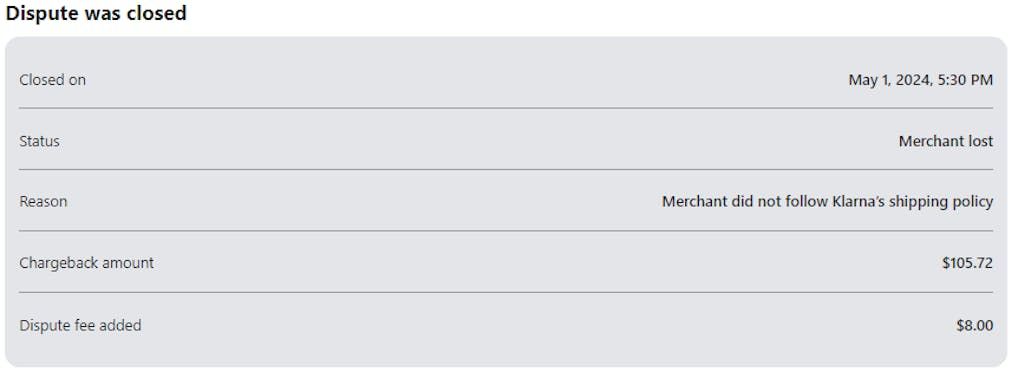
In the example provided, the dispute was ultimately lost because the merchant failed to respond to the request before the deadline, as stated in the ‘Reason’ field. As a result, the status of the scenario was updated to ´Merchant lost´. This led to a chargeback and a Dispute fee of EUR 15
Jump to section...